By admin, 3 May, 2013

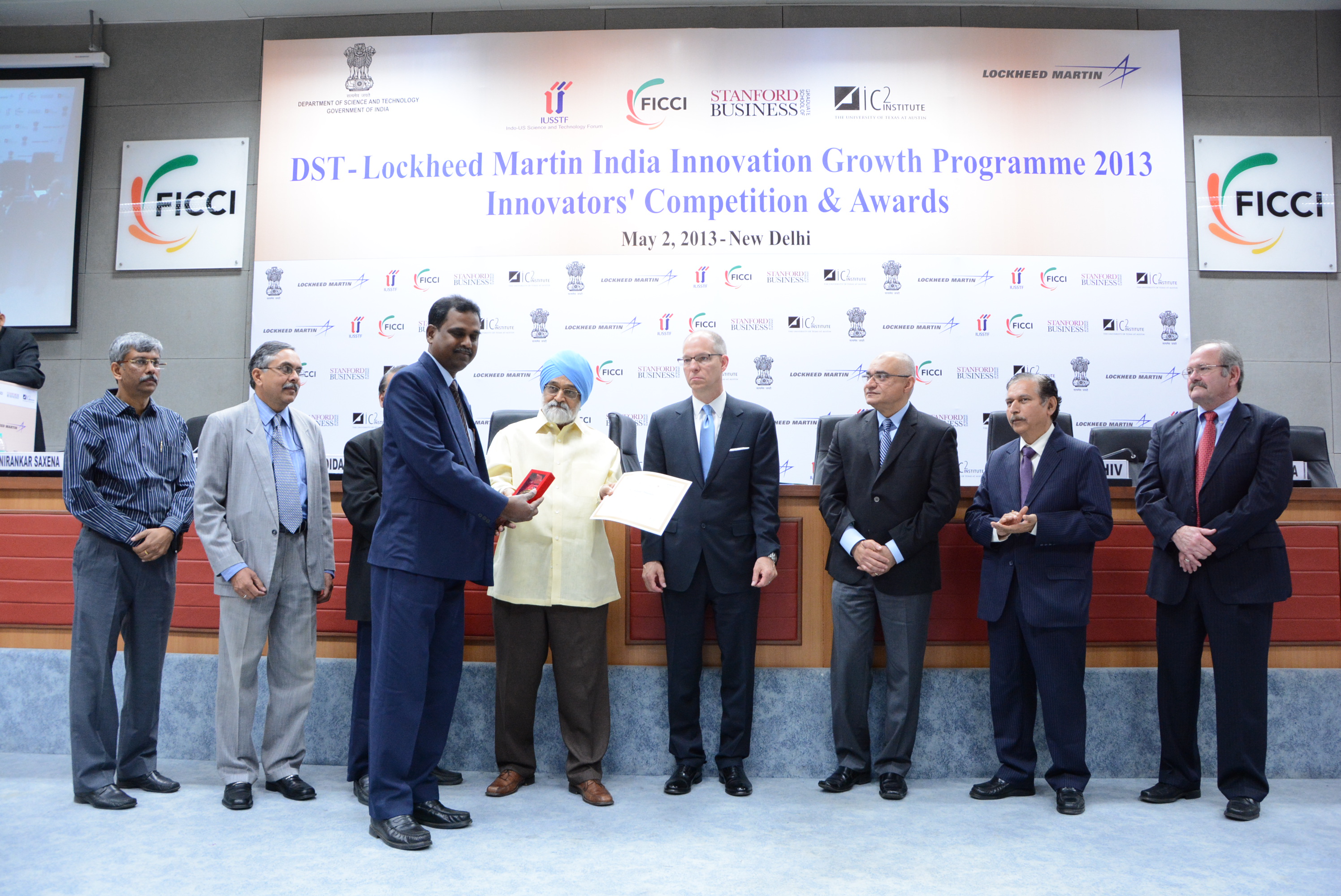
May 3rd 2013, Energy-XS receiving the DST-Lockheed Martin Award from the Chairman of the Planning Commission Dr. Ahluwalia, also present are Ray O. Johnson, CEO Lockheed Martins, Dr. Baba Shiv of Stanford Business, Sid Burback, Director IC2 University and others. The Innovation is a Vertical Axis Wind Turbine.

By admin, 9 April, 2013

I can’t understand why people are frightened of new ideas. I’m frightened of the old ones. -John Cage

Energy-XS is extremely happy to announce that its revolutionary VAWT technology has been selected among Top 50 Innovations in FICCI DST Lockheed Martin India Innovation Growth Programme. 

One key advantages of VAWT is that they do not need to be pointed into the wind to be effective. This is an advantage on sites where wind direction is highly variable. VAWT also obviate the need for massive towers and can be mounted closer to the ground or on rooftops. As the generator is closer to ground, it is easier to maintain. VAWT's have lower start up speeds than HAWT's, typically generating power at windspeeds as low as 2 to 3 m/s and may be installed at places where tall structures are prohibited.

Wind has a high energy density, and output improves geometrically as wind speed increases. The principle used to convert the kinetic energy in the wind to electrical energy is simple, we all know of old Dutch windmills, and the dynamo on our bicycle. Joined together they are a wind energy plant!
Even with the reduced cost of installed Solar PV per watt today (which is roughly Rs. 350/- per watt) an Energy-XS small wind system is still cheaper at one fourth that of solar PV on per watt basis. We use this price difference to engineer more reliable systems at greatly reduced prices as indicated above. Additional cost reduction happens as a result of the reduced battery backup needed in a Solar / Wind solution as against a pure solar or wind only solution.

Normally the Wind to Solar ratio recommended in India is 60/40. Our 8KW hybrid systems are configured for 40% Solar and 60% wind and we see over 50% savings in capital costs as against a solar only installation for the same wattage. However the smaller hybrid units such as the Energy-XS 33W hybrid system use under 3% as the solar element to keep costs down and ensure adequate charging during night time with a larger wind impeller.